
Spectra supercomputer tests adaptive chips for nuclear security
Source: interestingengineering
Author: @IntEngineering
Published: 12/8/2025
To read the full content, please visit the original article.
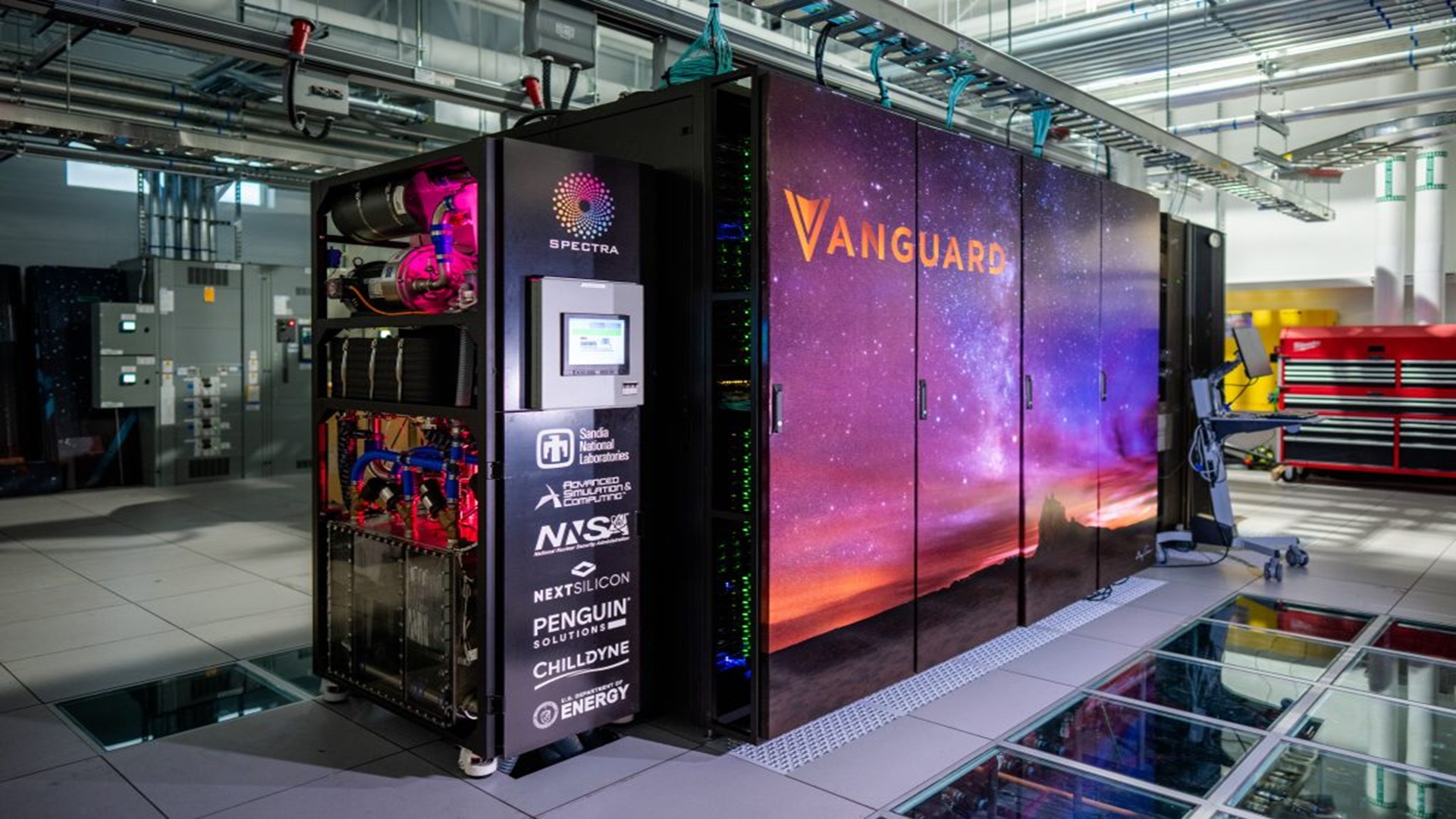
Read original articleSandia National Laboratories has introduced Spectra, a prototype supercomputer developed in partnership with NextSilicon, designed to revolutionize national security simulations through adaptive, efficiency-focused computing. Unlike traditional CPU and GPU-based systems, Spectra employs 128 Maverick-2 dual-die accelerators—experimental chips that dynamically analyze and prioritize code tasks in real time to enhance performance while reducing power consumption. This approach aims to improve the speed and efficiency of complex simulations critical to maintaining the safety and reliability of the U.S. nuclear deterrent without underground testing.
Spectra is the second system under Sandia’s Vanguard program, which tests cutting-edge technologies for potential large-scale deployment. Following the success of Astra, the first Vanguard machine that validated Arm processors for scientific workloads, Spectra seeks to demonstrate the viability of intelligence-driven, adaptive computing architectures. Early benchmarks, including HPCG, LAMMPS, and SPARTA, have shown promising results without requiring users to rewrite applications, potentially lowering the cost and complexity of
Tags
energysupercomputingadaptive-chipsnuclear-securityhigh-performance-computingpower-efficiencynational-laboratories